



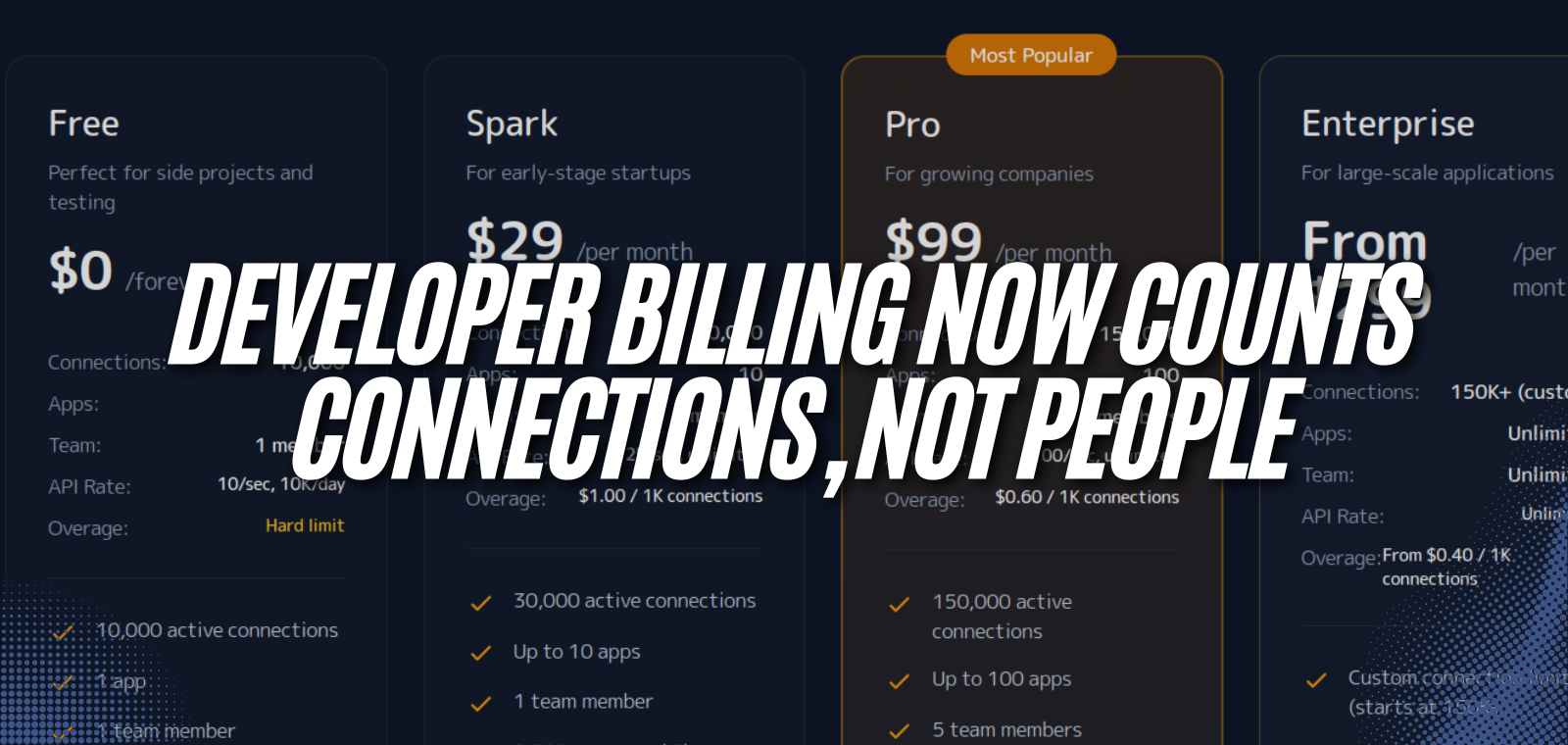
Developer Billing now counts connections, not people
Billing exists at Flowsta for exactly one reason: it pays for the network. The servers that answer sign-ins, the nodes that hold public records, the bootstrap infrastructure that lets Vaults find each other - developer plans are what keep that running, and what keep Flowsta free to use.
So the number those plans are billed on matters to everyone, not just developers - because behind every billing metric is a question about what gets counted, and counting usually means tracking. From today, that number is active connections: how many accounts were connected to an app in a calendar month. It replaces the metric we previously called monthly active users, and the redesign's whole point is that it counts without tracking anyone.
What an active connection is
One account that used its connection to an app at least once in a calendar month - a sign-in, a registration, a session verification, or use of a Vault-linked app. That's it.
The same person signing in to an app forty times in July is one active connection. Someone connected to two apps counts once for each - it's the connections being counted, and there are two of them. And an account that didn't touch an app this month counts as zero, no matter what it did last month.
If you use Flowsta apps: less leaves your Vault than ever
Counting unique accounts usually means following unique accounts - an identifier per person, threaded through analytics. We went the other way.
When you use your connection to an app, Flowsta's servers derive an opaque pseudonym from your account and that app - and store that. Nothing is collected from your device for counting. Nothing is stored in your data. The pseudonym can't be turned back into your email, your DID, or your profile - not by the app's developer, and not by anyone reading our billing tables - and it never travels anywhere.
For apps connected through your Flowsta Vault, the entire monthly usage record your Vault sends is this:
{
  "client_id": "flowsta_app_...",
  "month_year": "2026-07"
}
Which app. Which month. Not how often, not when, not from where, and not under any identifier at all. A month of heavy use produces exactly the same two fields as a month of light use. What the Vault Sends Home documents this record field by field, with links to the open-source code that sends it - the page and the code always agree.
If you build on Flowsta: one number renamed, nothing else
Your integration doesn't change. Same endpoints, same response fields, same tiers, same prices, same limits. Your dashboard now says "active connections" where it used to say MAU, the Developer Agreement defines the new term, and the pricing page carries the same definition in its FAQ.
What you see is "42 active connections this month," and that is genuinely all there is to see - for you and for us. You can't identify who connected, and neither can a copy of our analytics, because the information isn't in there. Your users get privacy they don't have to trust anyone for; you get the one number billing needs, and a data-handling story you can put in your own privacy policy with a straight face.
The principle underneath
Flowsta's model is that the only user-to-app links that should exist anywhere are the ones you can see and revoke yourself - the grants on your Connections page. Billing shouldn't need a second, hidden map of who uses what. Now it doesn't have one: the count is derived from the connections you already control, and the analytics store holds numbers, not people.
That's the network the plans pay for. Person to person. No one in control but you.